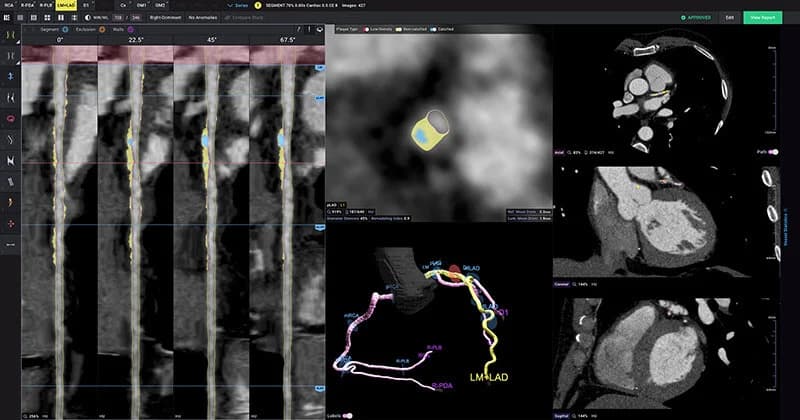
If you have looked into CT angiogram heart scans recently, you may have come across the name Cleerly. It is an AI software that takes images from a coronary CT angiogram and produces a detailed plaque analysis that goes well beyond what a human reader provides. But is a Cleerly heart scan worth the cost? Here is an honest, practical breakdown of what it does, what it costs, how accurate it is, and who benefits most from it.
What is a Cleerly heart scan?
A Cleerly heart scan is not a separate scan. It is an AI-powered plaque analysis that runs on the coronary CT angiogram data. You still get the same CT scan at an imaging center. The difference is what happens after: instead of only having a radiologist review your images, the images are also sent through Cleerly's FDA-cleared algorithms for a detailed plaque analysis.
Cleerly's software maps your coronary arteries in 3D, then identifies, measures, and categorizes every piece of plaque it finds. The result is a color-coded report showing exactly where plaque sits, how much there is, and what type it is: calcified (stable), soft (intermediate risk) and vulnerable (high risk).
Plaque type matters because not all plaque is equally dangerous. Hard, calcified plaque is generally stable. Soft plaque is generally more risky and more likely to rupture and cause a heart attack. A subtype of it, called vulnerable or thin cap plaque, is even more risky. A standard CT angiogram report notes whether plaque is present and estimates blockage severity, but it does not precisely measure plaque volume or reliably quantify different plaque types. That is where Cleerly adds the most value.
What is the difference between a CTA and a Cleerly?
A CTA (coronary CT angiogram) is the scan itself. Cleerly is an AI analysis that runs on the CTA images. You cannot get a Cleerly analysis without first having a CTA.
Standard CTA read vs CTA with Cleerly analysis
| Standard CTA read | CTA with Cleerly | |
|---|---|---|
| What it measures | Blockage severity (% narrowing) | Blockage severity + plaque volume, type, and location |
| Plaque categorization | Basic (calcified vs non-calcified) | Detailed breakdown: calcified, non-calcified, and low-density (high-risk) |
| How plaque is measured | Visual estimate by radiologist | AI-measured volume in cubic millimeters |
| Consistency | Varies between readers | Standardized, reproducible results |
| Tracking over time | Difficult to compare scans precisely | Quantitative measurements allow precise comparison |
| Blood flow assessment | Not included | Ischemia likelihood assessment available |
| Report format | Text-based radiology report | Color-coded 3D visual report + detailed metrics |
The CTA scan is the same in both cases. Cleerly adds an AI analysis layer on top of the standard radiologist read.
In Cleerly's own CERTAIN trial, adding Cleerly to a standard CTA read changed treatment decisions in over 57% of patients. It also led to a 37% reduction in the need for further testing and a 28% increase in preventive medication use. Those are significant numbers, and they show that the extra detail Cleerly provides changes how doctors manage patients.
How much does a Cleerly heart scan cost?
A Cleerly analysis typically costs between $500 and $1,500 on top of the CT angiogram itself. The total out-of-pocket cost for a CT angiogram plus Cleerly analysis ranges from about $1,500 to $3,000, depending on your location and imaging center.
Insurance coverage is expanding fast
Medicare now pays about $1,000 for AI plaque analysis
As of January 2026, AI plaque analysis has its own Medicare billing code (CPT 75577). Private insurers covering over 86 million Americans now cover it, including UnitedHealthcare, Cigna, Aetna, Humana, and several Blue Cross Blue Shield plans.
If your insurance covers it, your out-of-pocket cost could be much lower. Check with your insurer and imaging center before scheduling.
How accurate is a Cleerly heart scan?
Cleerly's AI is very accurate. In a head-to-head study run by Cleerly, which compared AI analysis to human readers, Cleerly's algorithm achieved an AUC of 0.91 for detecting significant blockages, compared to 0.77 for experienced radiologists. It was particularly better at negative predictions, meaning it more accurately ruled out disease when it was not present, reducing false alarms.
Accuracy: Cleerly AI vs human readers (detecting 50%+ blockages)
| Metric | Cleerly AI | Experienced radiologist |
|---|---|---|
| AUC (overall accuracy) | 0.91 | 0.77 |
| Sensitivity | 86% | 88% |
| Specificity | 81% | 62% |
| Accuracy | 83% | Not reported |
Data from a diagnostic accuracy study comparing AI-QCT to Level 3 CCTA readers, published in BMC Medical Imaging (2025).
The main takeaway: Cleerly matches experienced readers at finding disease and is significantly better at correctly identifying patients who do not have it. That distinction matters because overestimating blockages can lead to unnecessary invasive procedures.
Is a Cleerly scan worth it?
If cost is not a concern, adding Cleerly is worth considering. The AI analysis gives you a more detailed, more consistent picture of your heart arteries than a standard read alone. But the value depends on your situation.
Cleerly adds the most value if you:
- Have early or borderline findings on a standard CT angiogram and want to understand your plaque composition in detail.
- Have risk factors like high Lp(a), family history of heart disease, or elevated cholesterol and want to know if you have low-density vulnerable plaque.
- Had an ambiguous result and want a second, AI-powered opinion before next steps.
You may not need it if:
- Your CT angiogram shows a normal standard read.
- Your results clearly need intervention, for example, significant amount of blockage. In this case, the standard read already provides enough information.
Key finding from the CERTAIN trial
Cleerly changed treatment decisions in 57% of patients
In Cleerly's 750-patient study, Cleerly increased doctors' diagnostic confidence five-fold and reduced the need for further invasive and non-invasive testing by 37%. That means fewer unnecessary follow-up tests and more targeted treatment.
Is Cleerly covered by insurance?
Yes, it's covered when medically necessary and the coverage is growing rapidly. As of early 2026, Medicare covers AI plaque analysis under CPT code 75577 at a payment rate of about $1,000. On the private insurance side, major carriers including UnitedHealthcare, Cigna, Aetna, and Humana now cover it for patients who meet clinical criteria, typically those with chest pain or suspected coronary artery disease.
The bottom line
A coronary CT angiogram is already one of the best ways to get a good picture your heart health. Cleerly makes it better by adding precise, AI-driven plaque analysis that a standard human read cannot match. It's currently expensive and if cost is not a concern, it might be worth adding to your scan.
Whether Cleerly is right for you depends on your risk factors, your scan findings, and your insurance situation. But if you are already getting a CT angiogram, the additional detail Cleerly provides can help you and your doctor make more informed, more confident decisions about your heart health.
Confidence in your heart health
Our CT angiogram heart scan captures gives you a full picture of your coronary arteries, giving you peace of mind and control over your heart health.
References
- Cleerly Health
CERTAIN multicenter clinical trial results
- BMC Medical Imaging
Diagnostic accuracy in coronary CT angiography analysis: artificial intelligence versus human assessment
- STAT News
Medicare to cover $1,000 AI heart scans. Will cost match benefits?
- Cardiovascular Business
Reimbursement expected to drive implementation of CCTA, AI-powered plaque analysis
- Cleerly Health
CPT 1 code for AI coronary plaque analysis (CPT 75577)
- Kini et al., JACC: Cardiovascular Interventions
Vulnerable plaque characteristics: thin fibrous cap, lipid-rich core, and rupture risk